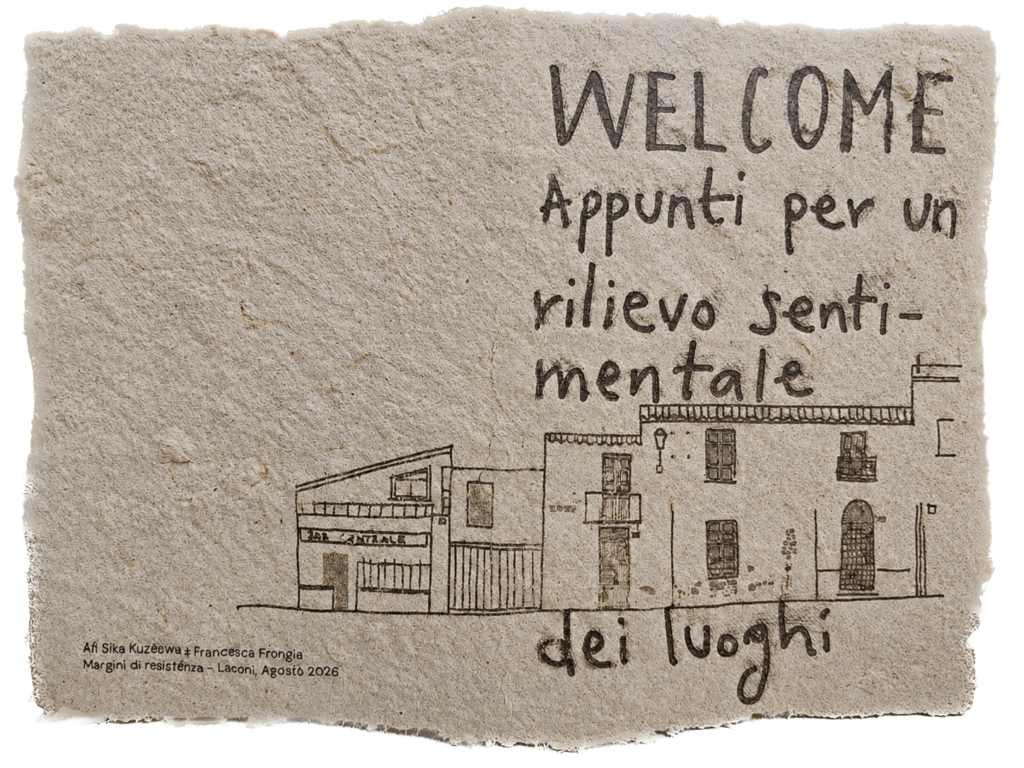
Notes for a Sentimental Survey
together with Francesca Frongia
Laconi, Sardinia
Within the festival “storie dal vicolo”
There’s a question we’ve had since our first day in Laconi, a town whose name comes from laconi, meaning border: what is the margin here? What does it mean to those who live there, and what does it suggest to those who cross it for the first time?
We weren’t looking for an abstract answer. We were looking for a crossing: of the town’s geographical boundaries, but also of social and individual boundaries, of memory, of the body.
This work is part of two larger projects, Sentimental Survey and Welcome Home. With the former, we attempt to leave traces of a way of experiencing places. With the latter, we explores how people who experience the world differently search for spaces, rhythms, relationships, and ways of living that support regulation, belonging, and a sense of inner arrival. For those who practice architecture, the survey is the tool that tends toward objectivity: measurements, elevations, distances. Here we try to broaden it—to also capture what cannot be measured with a ruler: personal, social, and community data. A building, a town, isn’t just made up of dimensions and technical diagnoses. It’s made up of intertwined eras, of lives, of private choices within collective dynamics of which we are often unaware. For those with a psychological and artistic approach, introspection and expression out of introspection is the way.
In this residency, we’ve chosen to look at neurodiversity as one of the many ways margins manifest themselves. A neurodivergent person feels, reacts, and inhabits a space in a way that isn’t “average”—and this, in a world built on average, creates friction: in conversations, at work, in the home, in the economy. People remain on the margins, almost always not by choice.
Yet that margin can also become a place of refuge. Bell hooks writes: “I make a clear distinction between marginality imposed by oppressive structures and that which is chosen as a place of resistance, as a place of radical openness and possibility.” High sensitivity is often a symptom of collective frustration with a system—except that those who suffer it first, and more than others, are a few. This is where margins become political: listening to the little bird in the mine, to those who warn before others that the conditions to which so many have become accustomed are, in reality, a danger for everyone.
Architects and designers can be a conduit. There is, in this profession, a very ancient holistic and systemic vocation—that of Leonardo, whom Fritjof Capra describes as the first great thinker capable of interpreting nature as an interconnected network (The Universal Science: Art and Nature in the Genius of Leonardo, Rizzoli), as well as African relational philosophies, particularly Ubuntu. Ubuntu understands personhood and flourishing as fundamentally relational—not only within human community, but also in relation to the more-than-human world. In ecological interpretations, this relationality encompasses the natural environment, other living beings, and, in some traditions, ancestral and spiritual dimensions. A vocation that today often remains hidden beneath the technical-regulatory folds of the profession: a veritable professional masking, which requires the architect to deny the very thing that, at times, led him to choose this profession.
The architect and the designer read and design. The neurodivergent inhabitant reacts and feels. In between, a margin that must be highlighted—not with a ruler, but with the gaze.
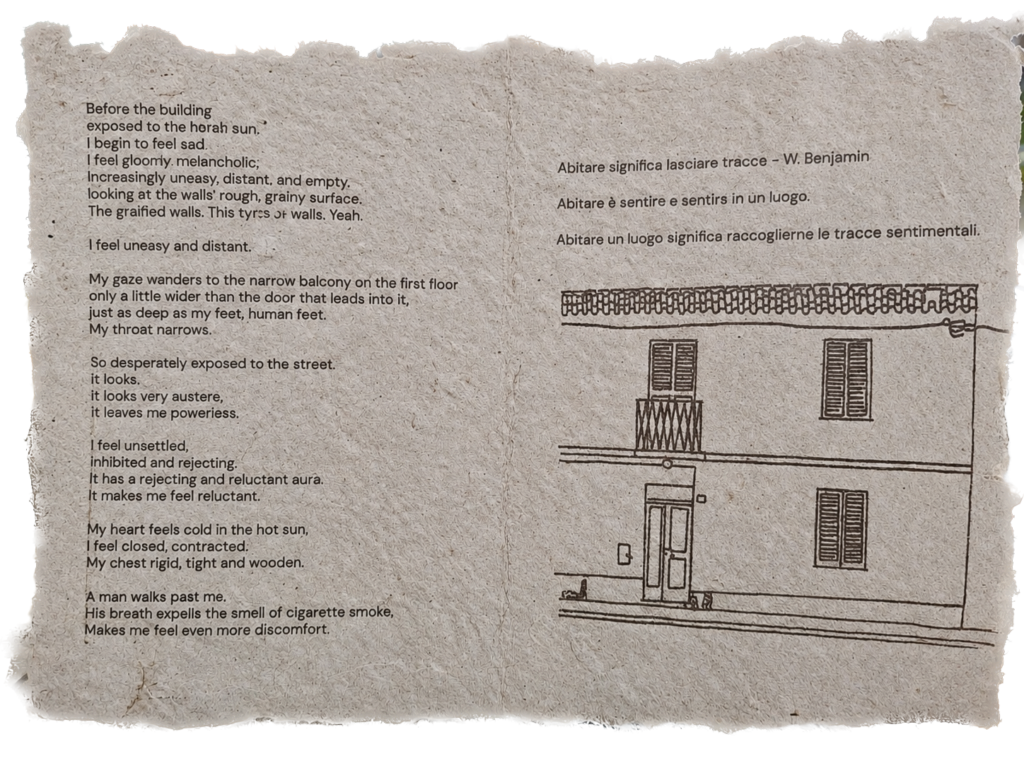
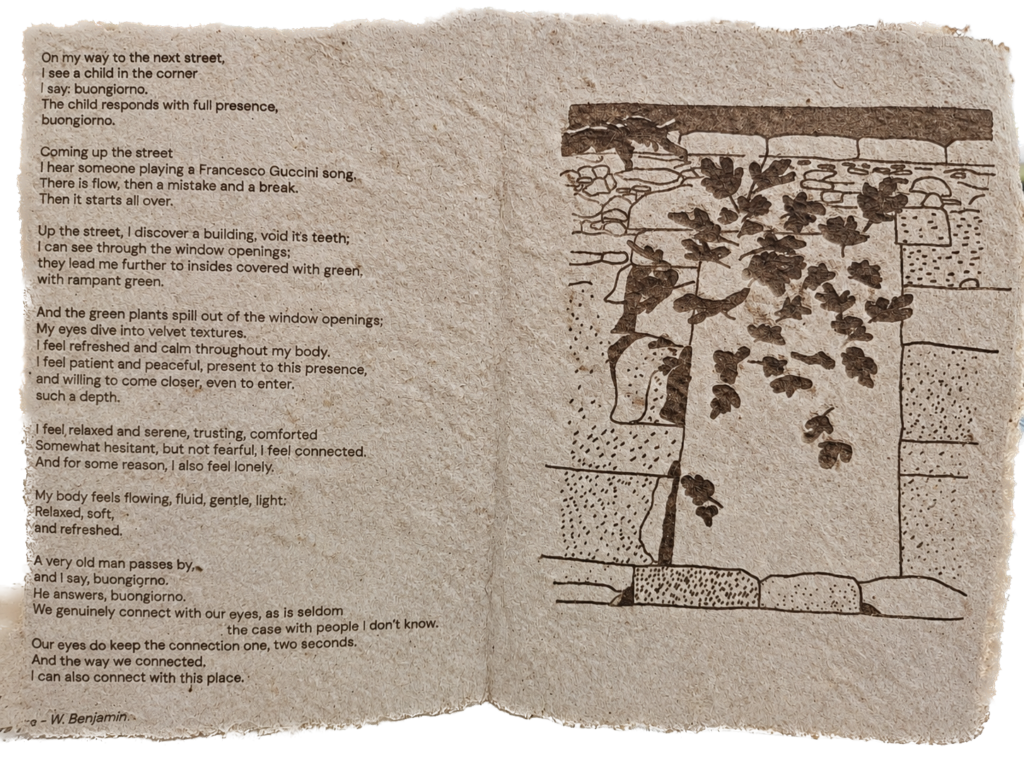
In Laconi, we drew and photographed several buildings that we felt could tell something about the town, and we interpreted their history starting from information, but also from intuition: because a building, like a town, cannot be told through dimensions alone.
This fanzine—handcrafted paper, somewhat rough, and fast—is the first visible edge of Rilievo sentimentale: not a conclusion, but a work in progress. We chose to make it affordable and reproducible, photocopiable, so that the content it conveys—this holistic and inclusive look at architecture, spaces, and places, starting with those who live on the margins—doesn’t remain marginalized either.
Afi Sika Kuzeawu (Text) & Francesca Frongia (Illustration, Engraving, Mashed Paper)